Read less. Remember more. This is !DueCourse™
Traditional legal education overwhelms.
Too much reading. No structure. Low retention.
!DueCourse™ changes that.
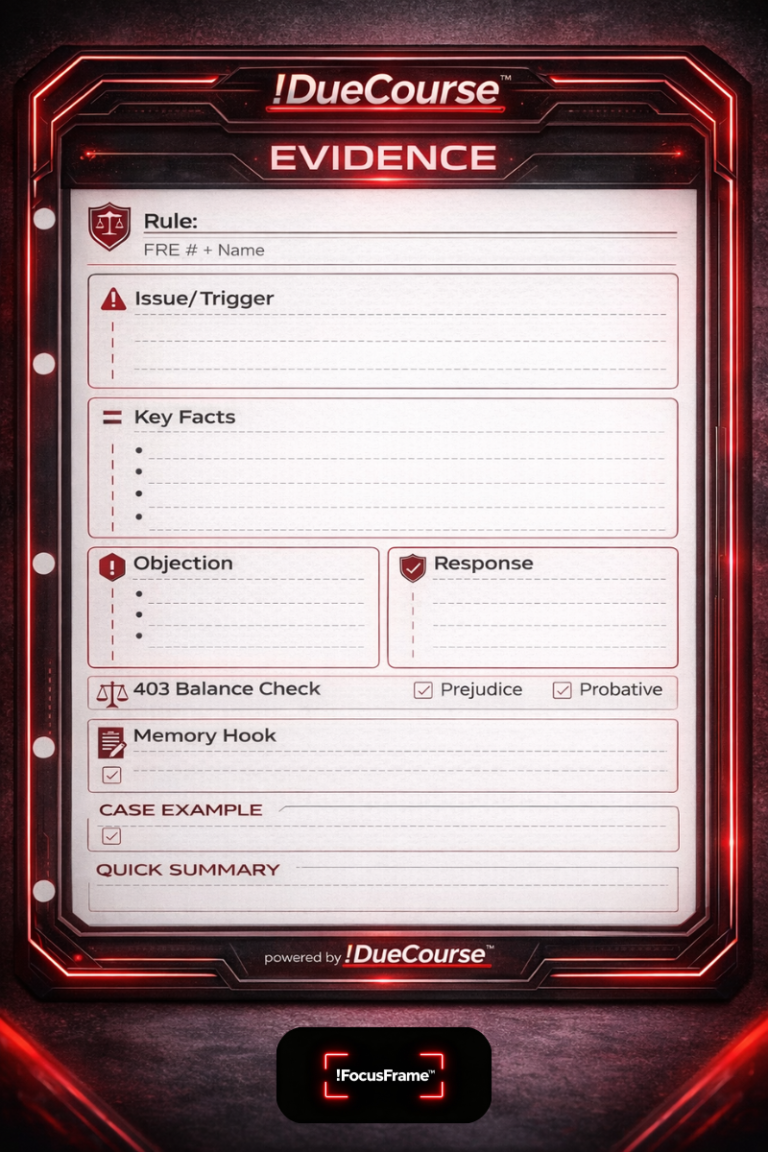
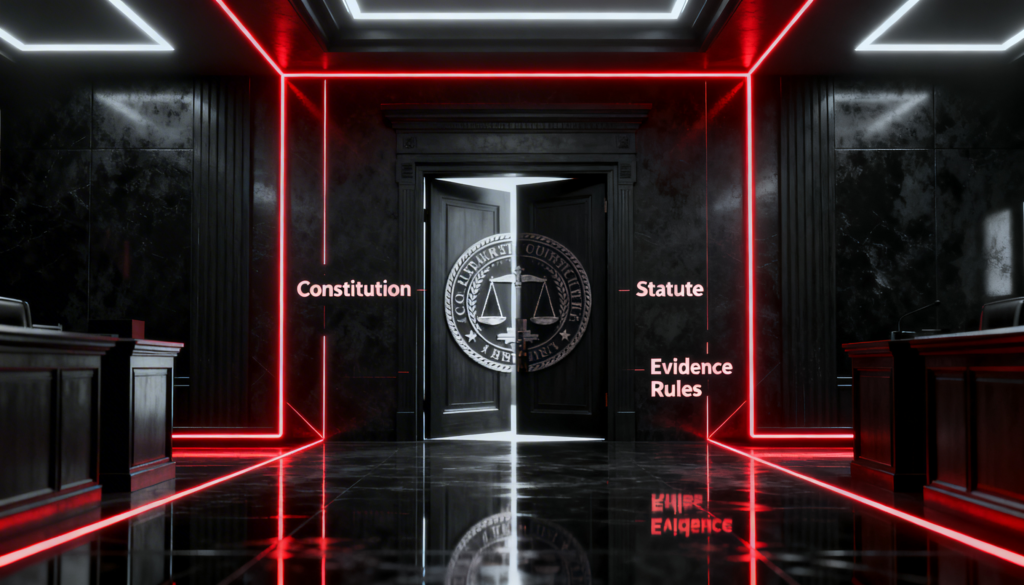
At the center is !FocusFrame™.
A visual overlay that reduces cognitive overload and directs attention where it matters most.
Instead of scattered information, you move through a focused pathway that improves recall and saves mental energy.
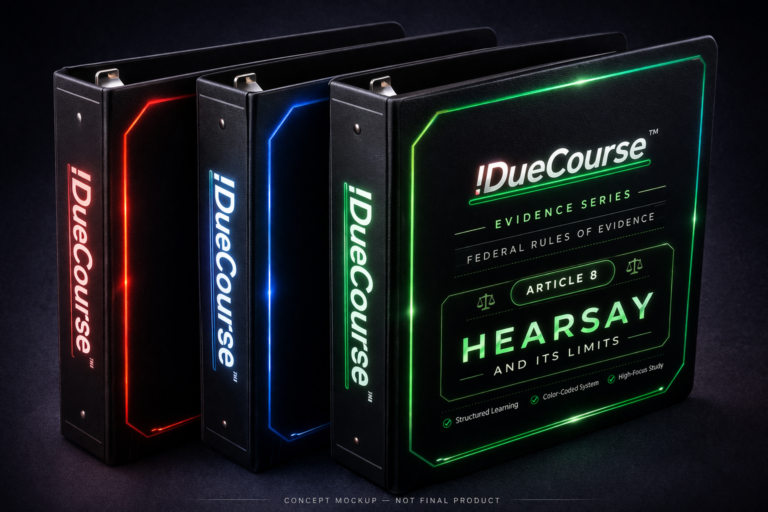
These are early concept designs for the !DueCourse™ system. No print runs yet. We are refining structure, layout, and usability before production.
The goal is simple: turn legal information into a structured system that improves focus, organization, and recall.
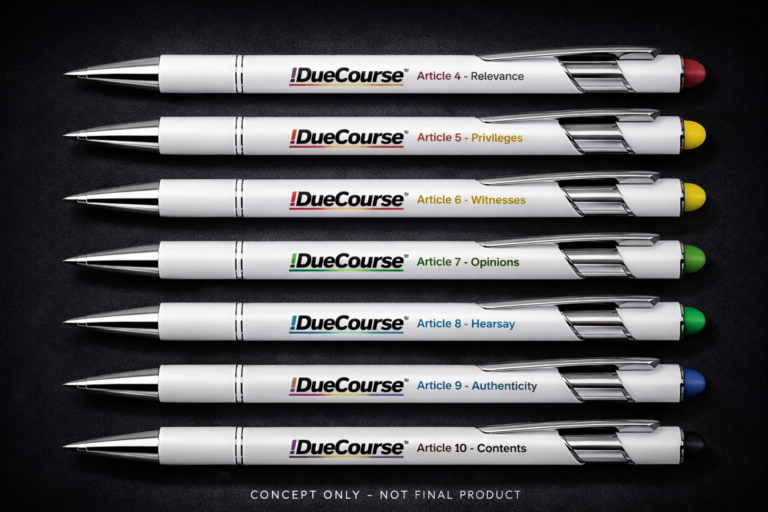
Each article of the Federal Rules of Evidence is paired with a specific color across notes, visuals, and tools.
By consistently linking color to concept, users train their brain to recognize and recall information faster.
For a deeper learning experience, users can follow along with the color-coded lessons and apply the same system using matching tools.
This creates a consistent learning environment built around structure, repetition, and recall.
These materials are conceptual and subject to revision. Final products may vary.
It turns the Federal Rules of Evidence into a visual system built for real understanding.
With guided flow, memory hooks, and structured analysis, complex rules like relevance, hearsay, and authentication become clear and usable.
This is not just studying.
This is a system.
This is not just studying.
This is a system.
Traditional legal education overwhelms. Endless reading. No structure. No retention.
!DueCourse™ changes that by turning the Federal Rules of Evidence into a visual system built for real understanding. Through guided flow, memory hooks, and structured analysis, complex rules like relevance, hearsay, and authentication become clear and usable.
At the center is !FocusFrame™. A visual learning overlay designed to reduce cognitive overload and direct attention exactly where it matters. Instead of scattered information, you move through a controlled pathway of focus that helps conserve mental energy and improve recall.
This is not just studying. This is a system.
Learn how evidence actually works. Apply it with confidence. Build legal thinking that sticks.
Learn how evidence works.
Apply it with confidence.
Build legal thinking that sticks.
Introduction
Each !DueCourse™ article uses a distinct color theme and binaural beat to reinforce memory and recognition.
This section features the red theme for Article IV, with consistent visuals and audio designed to strengthen recall.
See video INFRA for full concept of the video portion.
The Federal Rules of Evidence govern what information may be presented in court and how that information is evaluated. They shape the foundation of legal argument, determining not only what evidence is admissible, but how facts are proven, challenged, and understood.
Despite their importance, Evidence remains one of the most difficult subjects for students and early legal professionals. The challenge is not simply the language of the rules, but the way they interact. Evidence is not learned in isolation. It operates as a system.
!DueCourse™ approaches Evidence differently—by teaching structure, flow, and application from the start.
Why Evidence Is Difficult
Traditional legal education focuses on memorization.
That alone is not enough.
Applying Evidence requires real-time analysis:
• Is it relevant under Rules 401 and 402
• Does Rule 403 exclude it
• Are there exceptions or limits
• Can you spot the issue fast
Evidence is layered.
That is what makes it difficult, and essential to learn correctly.
Traditional legal education often emphasizes memorization of individual rules. While necessary, memorization alone does not prepare students to analyze evidence in real time.
In practice, applying the Federal Rules of Evidence requires:
Identifying whether evidence is relevant under Rules 401 and 402
Weighing admissibility against Rule 403 considerations
Recognizing exclusionary rules and exceptions
Spotting issues quickly under pressure
This layered analysis is what makes Evidence challenging, and what makes it essential to learn correctly.
The !DueCourse™ Approach
!DueCourse™ simplifies Evidence into structured, repeatable analysis.
It focuses on:
• Flow over fragments, how rules connect
• Visual frameworks, easier to retain
• Short explanations, less overload
• Application first, real issue spotting
Not just what the rule says.
How it operates in context.
!DueCourse™ is designed to simplify Evidence by turning complex doctrine into structured, repeatable analysis.
The system focuses on:
• Flow over fragments
understanding how rules connect, not just what they say
• Visual learning
frameworks – making abstract rules easier to retain
• Short-form
explanations – reducing cognitive overload
• Application-first
learning – training issue spotting and real-world use
Instead of asking “What does this rule say?”
!DueCourse™ asks: “How does this rule operate in context?”
A System Built Around Core Rules
At the center are Rules 401, 402, and 403.
Rule 401 defines relevance.
Rule 402 allows relevant evidence in.
Rule 403 may still exclude it for fairness.
Everything flows through this framework.
Understand this, and Evidence becomes a system, not memorization.
At the center of the Evidence framework are Rules 401, 402, and 403.
Relevance under Rule 401 opens the door.
Rule 402 allows relevant evidence to be admitted.
Rule 403 ensures that even relevant evidence may be excluded when fairness demands it.
These rules form the foundation through which all other evidence must pass.
Understanding this structure transforms Evidence from a memorization-heavy subject into a logical system.
Built for Real Legal Application
!DueCourse™ is built for real-world use.
For students, it improves understanding and retention.
For paralegals, it sharpens issue spotting and preparation.
For attorneys, it strengthens recall and supports faster, confident objections.
It connects learning to practice.
!DueCourse™ is built with real-world use in mind.
For students, it strengthens comprehension and retention.
For paralegals, it improves issue spotting and case preparation.
For attorneys, it reinforces recall and supports faster, more confident objections and arguments.
By focusing on how Evidence is actually used, the system bridges the gap between learning and practice.
Looking Forward
Looking Forward
The Federal Rules of Evidence rarely change.
That makes them ideal for a stable, scalable system.
The !DueCourse™ Evidence Series is built for long-term growth, including modules, visual tools, and future CLE content with licensed professionals.
This is not just a study aid.
It is a better way to learn law.
The Federal Rules of Evidence change infrequently, making them ideal for building a stable, scalable learning system.
The !DueCourse™ Evidence Series is designed as a long-term project, with plans to expand into structured modules, visual learning tools, and Continuing Legal Education (CLE) content developed in collaboration with licensed professionals.
This is not just a study aid.
It is a foundation for a more efficient, practical approach to legal education.